Showing posts with label Black Hole. Show all posts

Tuesday, 30 December 2008

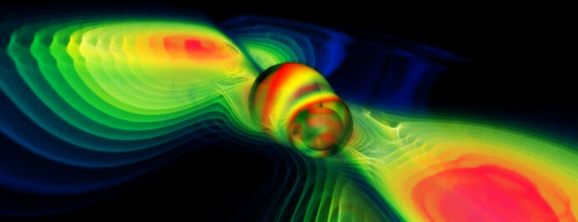
Studying Black Holes Using a PlayStation 3


Source: Universe Today
Image Credit: K. Thorne (Caltech) , T. Carnahan (NASA GSFC)

If you're a PlayStation 3 fan, or if you just received one as a holiday gift, you may be able to do more with the system than just gaming. A group of gravity researchers have configured 16 PlayStation 3's together to create a type of supercomputer that is helping them estimate properties of the gravitational waves produced by the merger of two black holes. The research team from the University of Alabama in Huntsville and the University of Massachusetts, Dartmouth, calls their configuration the Gravity Grid, and they say the Sony PlayStation 3 has a number of unique features that make it particularly suited for scientific computation. Equally important, the raw computing power per dollar provided by the PS3 is significantly higher than anything else on the market today.(Read more)

Friday, 12 December 2008

Astronomers Dissect a Supermassive Black Hole with Natural Magnifying Glasses

Source: ESO

Combining a double natural "magnifying glass" with the power of ESO's Very Large Telescope, astronomers have scrutinised the inner parts of the disc around a supermassive black hole 10 billion light-years away.
They were able to study the disc with a level of detail a thousand times better than that of the best telescopes in the world, providing the first observational confirmation of the prevalent theoretical models of such discs.(read more)

Friday, 9 May 2008

Stars Orbiting Close to Black Holes Flattened like Hot Pancakes


Source: Universe Today

Playing with black holes is a risky business, especially for a star that is unlucky enough to be orbiting one. Assuming an unfortunate star hasn't already had all of its hydrogen fuel and other component elements stripped from its surface, the powerful tidal forces will have some fun with the doomed stellar body. First the star will be stretched out of shape and then it will be flattened like a pancake. (read more)

Wednesday, 23 April 2008

Black hole sheds light on a galaxy


Source: arXiv, Max Planck Institute for Extraterrestrial Physics

Light echo of a high-energy flash from a black hole first observed in detail. The flare almost certainly originates from a single star being gravitationally ripped apart by a supermassive black hole in the galactic core. The sudden burst of radiation was produced as the star was being pulled into the into the black hole accretion disk.(read more)

Links:
Universe Today

Wednesday, 16 April 2008

Milky Way's Black Hole Gave Off a Burst 300 Years Ago


Source: ESA

Our Milky Way's black hole is quiet - too quiet - some astronomers might say. But according to a team of Japanese astronomers, the supermassive black hole at the heart of our galaxy might be just as active as those in other galaxies, it's just taking a little break. Their evidence? The echoes from a massive outburst that occurred 300 years ago. (read more)

Thursday, 10 April 2008

What Happens When Three Black Holes Collide?


Source: Universe Today

The consequences of two black holes colliding may be huge, the energy produced by such a collision could even be detected by observatories here on Earth. Ripples in space-time will wash over the Universe as gravitational waves and are predicted to be detected as they pass through the Solar System. Taking this idea one step further, what would happen if three black holes collide? Sound like science fiction? Well it's not, and there is observational evidence that three black holes can cluster together, possibly colliding after some highly complex orbits that can only be calculated by the most powerful computers available to researchers. (read more)

Wednesday, 2 April 2008

Astronomers Find the Smallest Black Hole


Source: NASA

Black holes seem to have no upper limit; some weigh in at hundreds of millions of times the mass of the Sun. But how small can they be? Astronomers have discovered what they think is the least massive black hole ever seen, with a mere 3.8 times the mass of the Sun, and a diameter of only 25 km (15 miles) across.
(read more)