Based on the outstanding success of the first tandem mission between ERS-2 and Envisat last year, ESA has paired the two satellites together again to help improve our understanding of the planet. (read more)
An image taken by the Opportunity rover that appears to show a plank of wood laying on the surface of Mars. The image, above, (here's the full resolution image) was taken in May of 2004, about four and a half years ago, in the early part of the Mars Exploration Rover mission.(read more)
New rifts have developed on the Wilkins Ice Shelf that could lead to the opening of the ice bridge that has been preventing the ice shelf from disintegrating and breaking away from the Antarctic Peninsula.(read more)
Jupiter has a rocky core that is more than twice as large as previously thought, according to computer calculations by a University of California, Berkeley, geophysicist who simulated conditions inside the planet on the scale of individual hydrogen and helium atoms. The results were published in Astrophysical Journal Letters. The simulation predict the properties of hydrogen-helium mixture. (Read more)
Two of our galaxy's most massive stars, until recently shrouded in mystery, have been viewed by the NASA/ESA Hubble Space Telescope, unveiling greater detail than ever before.(read more)
This is the last post of the 2007-2008 School Year. It was fun to be posting news of all these daily advances about astronomy and about our project. We hope you've enjoyed coming to see what new things were happening daily. We wish all of you the best dark skies during your Summer vacations.
See you
The eTwinning Project "The Sky above our Towns" participants
In order to recognise the outstanding work of eTwinning projects across Europe, the European Quality Label was launched in 2006. The fourth round of schools has now been finalised and Escola Secundária de Loulé and Zespół Szkół Zawodowych im. St. Staszica were awarded for there project "The sky above my town" that generated not only this blog but also the Astronomy webpage at "http://www.astro-etwinning.org".
Data from the MESSENGER spacecraft's first flyby of Mercury in January of 2008 are now turning into science results. Mercury's surface doesn't seem exactly as expected with som new features. MESSENGER data has also identified and mapped surface rock units that correspond to lava flows, volcanos, and other geological features, showing an apparent planet-wide iron deficiency in Mercury's surface rocks. (read more)
eTwinning National Quality Labels are granted to teachers with excellent eTwinning projects. They indicate that the project has reached a certain national standard. Escola Secundária de Loulé has now been awarded with the National Quality Label for the project "The sky above my town".
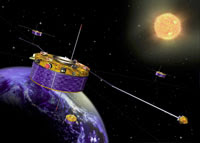
The first thing an alien race is likely to hear from Earth is chirps and whistles, a bit like R2-D2, the robot from Star Wars. In reality, they are the sounds that accompany the aurora. Now ESA’s Cluster mission is showing scientists how to understand this emission and, in the future, search for alien worlds by listening for their sounds.(read more)
The ESA/NASA SOHO spacecraft has just discovered its 1500th comet, making it more successful than all other comet discoverers throughout history put together. Not bad for a spacecraft that was designed as a solar physics mission. (read more)
NASA's Cassini mission is closing one chapter of its journey at Saturn and embarking on a new one with a two-year mission that will address new questions and bring it closer to two of its most intriguing targets-Titan and Enceladus. (read more)
Another groundbreaking discovery from Mars: Phoenix has analysed martian regolith containing minerals more commonly found in soil here on Earth, and the acidity is not a hindrance for life to thrive. These new and very exciting results come after preliminary analyses of a scoop of regolith by the landers "wet lab" known as the Microscopy, Electrochemistry and Conductivity Analyzer (MECA) instrument. Although more data collecting needs to be done, trace levels of nutrients have already been detected. This, with the recent discovery of water ice, has amazed mission scientists, likening these new results to "winning the lottery." (read more)
Seyfert galaxies appear to be normal spiral galaxies, but they have fluctuating bright centers. And now, their deep-down, hidden nature has been revealed: they are cannibals. While visible-light images didn’t provide much evidence that these galaxies had any interaction with their neighbors, radio-telescope images from the Very Large Array revealed that Seyfert galaxies are snacking on neighboring galaxies, with the "meal" feeding the supermassive black hole at their centers. Astronomers had suspected this was the case, but until now, they didn’t have the evidence to support the idea. (read more)
Although we haven't figured out everything in the universe by a long shot, we're getting a pretty good a handle on how things work in our world, and how the laws of nature operate here at home. One big question we have is, would laws of nature as we know them function the same at other locations in the universe? A new study says, yes. Research conducted by an international team of astronomers shows that one of the most important numbers in physics theory, the proton-electron mass ratio, is almost exactly the same in a galaxy 6 billion light years away as it is in Earth's laboratories, approximately 1836.15. (read more)
Phoenix's scientific team team held a press conference today to officially make their big announcement, which was fairly evident from pictures on the Phoenix website late yesterday: They found what they have been looking for. "It is with great pride and lot of joy that announce today we have found the proof that we have been seeking that show that this hard, white material is water ice," said the project's principle investigator Peter Smith. The image here shows a trench dug by Phoenix's robotic arm scoop that exposed a white area, and left a couple of small chunks of white material, which scientists thought could possibly be ice. (read more)
CERN (the European Organization for Nuclear Research) has concluded in another approved safety report that the LHC is harmless and will not hurt us, our planet or the Universe. Some people have been afraid that LHC might generate a black hople that would suck Earth to it's interior. This new investigation builds on previous findings that the LHC is safe, reiterating what scientists have been telling us for years. (read more)
In our project, one of the topics that has had more focus is the topic about Nibiru. This concern is similar to the concern mankind has since early 20th Century about an astronomical doomsday. Here is a nice article about it. (read more)
At last we are seeing big rewards in the hunt for "super-Earths" - rocky alien worlds a few times more massive than our own. While the vast majority of the almost 300 previously discovered exoplanets are Jupiter-like gas giants, the new discoveries of large numbers of small planets – and especially that at least three of them orbit one star — suggests that they are abundant in our galaxy, and may outnumber Jupiter-sized giants by 3 to 1. But are these planets like Earth? (read more)
There's no water in the results from the first sample of Mars regolith to be baked in Phoenix's oven. After a difficult time of actually delivering the sample to the Thermal and Evolved Gas Analyzer (TEGA) - a.k.a. the "oven" - scientists were hopeful for a clear science run. However, the sample was waiting on the deck of Phoenix for some time until tests could be carried out on the sample; it seems probable that any water ice will, if existed, have sublimed into the thin atmosphere. (read more)
Sometimes you just can't believe your eyes. This week is one of those times. Check out the full Moon on June 18th and prepare to be deceived! (read more)
Today, at an international conference, a team of European astronomers announced a remarkable breakthrough in the field of extra-solar planets. Using the HARPS instrument at the ESO La Silla Observatory, they have found a triple system of super-Earths around the star HD 40307. Moreover, looking at their entire sample studied with HARPS, the astronomers count a total of 45 candidate planets with a mass below 30 Earth masses and an orbital period shorter than 50 days. This implies that one solar-like star out of three harbours such planets. (read more)
What happened before the Big Bang? The conventional answer to that question is usually, "There is no such thing as 'before the Big Bang.'" That's the event that started it all. But the right answer, says physicist Sean Carroll, is, "We just don't know." Carroll, as well as many other physicists and cosmologists have begun to consider the possibility of time before the Big Bang, as well as alternative theories of how our universe came to be. Carroll discussed this type of "speculative research" during a talk at the American Astronomical Society Meeting last week in St. Louis, Missouri. (read more)
The International Astronomical Union has decided on the term plutoid as a name for dwarf planets like Pluto at a meeting of its Executive Committee in Oslo.(read more)
Wilkins Ice Shelf has experienced further break-up with an area of about 160 km² breaking off from 30 May to 31 May 2008. ESA’s Envisat satellite captured the event – the first ever-documented episode to occur in winter. (read more)
Nearly four decades after humans first set foot on the Moon, our astronomical neighbour is still exerting a powerful attraction for would-be explorers. Several private teams of scientists have already started working to land the first ever commercially-funded robot on the surface, in a race worth millions in prize-money to the winners. EuroNews met these teams. (read more)
NASA's Phoenix Mars Lander has filled its first oven with Martian soil. Under the surface soil a white material, that can be ice or salt, can be seen in the image.
"We have an oven full," Phoenix co-investigator Bill Boynton of the University of Arizona, Tucson, said today. "It took 10 seconds to fill the oven. The ground moved." (read more)
ESA's orbiting X-ray observatory XMM-Newton has re-discovered an ignored celestial gem. The object in question is one of the youngest and brightest supernova remnants in the Milky Way, the corpse of a star that exploded around 1000 years ago.(read more)
 Source: ESA




 Source: ESO


